Hospital Billing Software: Features, Benefits & How It Works
Introduction
In today’s fast-paced healthcare environment, an efficient hospital billing system is crucial for ensuring seamless operations and financial stability. Hospital billing software in India is revolutionizing the way medical facilities manage their financial transactions, enhancing accuracy and streamlining processes. This blog post delves into the essential features and benefits of various types of billing software, including medical billing software, OPD billing software, IPD billing software, and hospital invoice software. Additionally, we will explore the integration of TPA billing software and GST billing software, which are vital for compliance and effective management of third-party payer interactions. Whether you’re a healthcare professional, a business owner in the medical field, or simply interested in the advancements of hospital billing solutions, this post will provide you with a comprehensive overview of how these systems work and their impact on the healthcare industry.
Hospital billing systems are designed to optimize revenue cycle management by automating billing processes and minimizing the potential for errors. The implementation of hospital billing software in India enables healthcare providers to efficiently handle patient invoicing, insurance claims, and payment processing. By utilizing specialized OPD and IPD billing software, institutions can enhance patient experience and ensure timely reimbursements. Furthermore, the incorporation of TPA and GST billing software solutions facilitates seamless compliance with regulatory requirements, thereby improving overall operational efficiency.
Hospital billing is much more than generating an invoice. Every day, hospitals need to manage consultation charges, admission charges, procedures, medicines, laboratory tests, room charges, doctor fees, discounts, advances, refunds, insurance claims and final settlements.
When these activities are managed manually or through disconnected systems, hospitals can face billing errors, missed charges, delayed payments and difficulty tracking revenue.
Hospital Billing Software provides a centralized way to manage these financial workflows while connecting billing with other hospital departments.
Modern hospital billing systems can connect OPD, IPD, pharmacy, laboratory, insurance and patient records so that charges can be captured and reflected more efficiently. SWI Hospital Billing Software, for example, is designed to integrate OPD, IPD, pharmacy and laboratory billing within its broader Hospital Management Software platform.
In this guide, we will explain what hospital billing software is, how it works, its key features, benefits and what hospitals should consider when choosing a billing system.
What Is Hospital Billing Software?
Hospital Billing Software is a digital system used to manage the financial and billing activities of hospitals, clinics, nursing homes and other healthcare organizations.
Instead of maintaining separate records for every department, an integrated billing system can bring different chargeable services into a centralized workflow.
Depending on the software, hospitals can manage:
- OPD consultation billing
- IPD admission and discharge billing
- Pharmacy billing
- Laboratory billing
- Procedure and service charges
- Package billing
- Advance payments
- Discounts
- Refunds
- Payment settlements
- Insurance and TPA billing
- GST invoices
- Outstanding payments
- Revenue reports
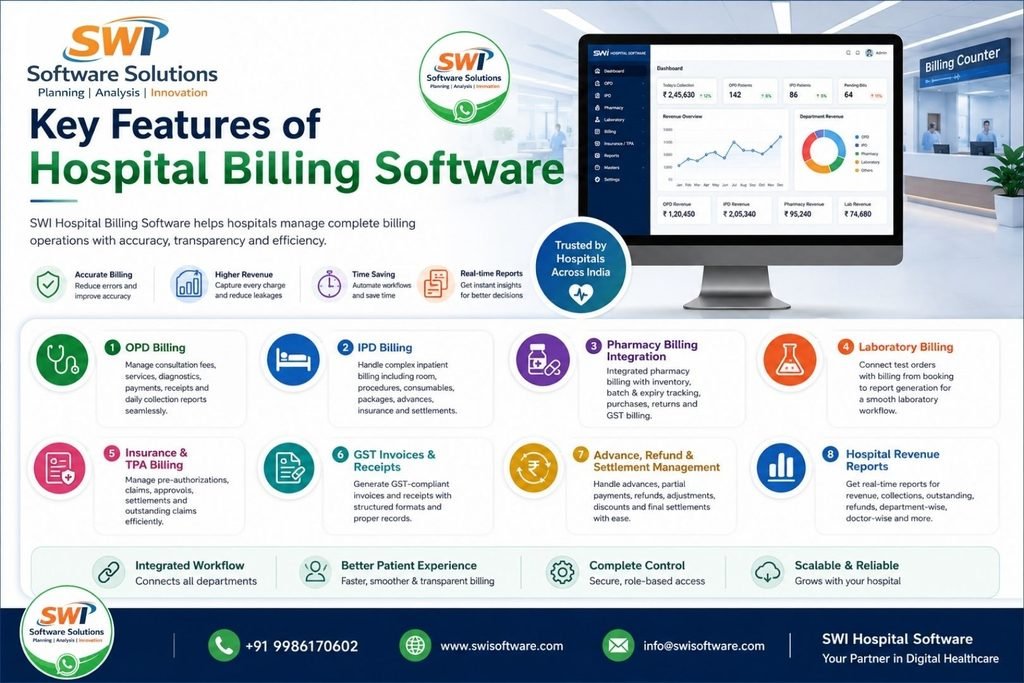
For example, SWI Hospital Billing Software provides billing functionality for OPD, IPD, pharmacy and laboratory services, along with invoices, receipts, advances, refunds, settlements and financial reports.
Why Do Hospitals Need Billing Software?
Traditional hospital billing can involve multiple departments and hundreds or thousands of transactions.
Consider an inpatient who receives:
- Doctor consultation
- Room accommodation
- Nursing services
- Laboratory tests
- Radiology
- Medicines
- Procedures
- OT services
- Consumables
If each department records charges separately, staff may have to manually collect and reconcile information before preparing the final bill.
This creates opportunities for:
- Missed charges
- Duplicate entries
- Incorrect amounts
- Delayed billing
- Disputes
- Difficulty tracking outstanding payments
- Manual reconciliation work
An integrated Hospital Management System can connect these workflows.
For example, SWI HMS connects billing with OPD, IPD, EMR/EHR, pharmacy, laboratory and other hospital modules.
Key Features of Hospital Billing Software
1. OPD Billing
OPD departments handle a large number of daily patient visits.
A hospital billing system can help manage consultation fees, service charges, diagnostic charges and other outpatient transactions.
Important OPD billing features may include:
- Patient registration integration
- Doctor-wise consultation fees
- Service billing
- Discounts
- Payment collection
- Receipt generation
- Outstanding tracking
- Daily collection reports
SWI’s OPD workflow connects registration, appointments, consultations, prescriptions, diagnostics, pharmacy and billing, helping create an integrated outpatient process.
Learn more about OPD Management Software.
2. IPD Billing
Inpatient billing is more complex because patients may stay for several days and receive services from multiple departments.
IPD billing software can help hospitals manage:
- Admission charges
- Room and bed charges
- Doctor visits
- Nursing charges
- Procedures
- Laboratory investigations
- Pharmacy charges
- Consumables
- Packages
- Advances
- Discounts
- Insurance/TPA billing
- Interim bills
- Final bills
- Discharge settlements
When IPD billing is connected with other hospital departments, charges can be captured more efficiently instead of relying entirely on manual data entry.
3. Pharmacy Billing Integration
Pharmacy transactions are an important part of hospital revenue and patient services.
Integrated pharmacy billing can connect medicine sales with inventory and patient billing.
Typical features include:
- Medicine billing
- Batch tracking
- Expiry tracking
- Purchase management
- Supplier management
- Stock management
- Returns
- GST billing
- Payment tracking
SWI’s pharmacy module includes medicine inventory, batch and expiry tracking, supplier workflows and pharmacy billing.
See Pharmacy & Stores Management Software for more information.
4. Laboratory Billing
Laboratory services can generate a significant number of transactions in hospitals and diagnostic centers.
Hospital billing software can connect laboratory test orders and billing so that staff do not have to repeatedly enter the same information.
A connected workflow can include:
Patient Registration → Test Booking → Sample Collection → Laboratory Processing → Report → Billing
Laboratory management systems can also support test registration, sample tracking, report generation and laboratory billing.
This type of integration can help reduce duplicate data entry and improve coordination between departments.
5. Insurance and TPA Billing
Insurance and TPA billing can be considerably more complicated than cash billing.
Hospitals may need to manage:
- Patient insurance information
- TPA details
- Pre-authorization
- Approved amounts
- Patient share
- Insurance share
- Claim submission
- Claim status
- Settlement
- Outstanding claims
SWI provides a dedicated insurance and TPA workflow for pre-authorization, claim tracking, documentation and settlement management.
For hospitals handling a significant number of cashless or insurance patients, this functionality can be an important part of selecting hospital billing software.
6. GST Invoices and Receipts
Hospitals often need structured invoices and receipts for their financial operations.
A modern billing system can help generate standardized invoices and maintain transaction records.
SWI’s hospital billing solution includes GST invoices and receipts as part of its billing functionality.
However, hospitals should configure taxation according to their actual services and applicable regulations and obtain appropriate professional advice where required.
7. Advance, Refund and Settlement Management
Patient billing does not always end with a single payment.
Hospitals may need to process:
- Advance payments
- Partial payments
- Refunds
- Adjustments
- Discounts
- Credit balances
- Final settlements
A billing system can maintain these transactions against the patient’s account and provide a clearer financial history.
This is especially useful for IPD patients whose final bill may be calculated after several days of treatment.
8. Hospital Revenue Reports
Hospital administrators need visibility into financial performance.
Hospital billing software can provide reports such as:
- Daily collection
- OPD revenue
- IPD revenue
- Pharmacy revenue
- Laboratory revenue
- Doctor-wise revenue
- Department-wise revenue
- Payment-mode reports
- Outstanding reports
- Refund reports
- Insurance/TPA reports
SWI’s broader HMS includes real-time reports and analytics designed to provide visibility across hospital departments.
How Does Hospital Billing Software Work?
A typical integrated hospital billing workflow can look like this:
Step 1: Patient Registration
The patient is registered and receives a unique patient identifier.
Step 2: Consultation or Admission
For OPD, the patient visits a doctor.
For IPD, the patient is admitted and assigned to a bed or room.
Step 3: Services Are Added
The patient may receive consultations, investigations, medicines, procedures or other services.
Step 4: Charges Are Captured
The billing system records applicable charges against the patient account.
Step 5: Department Integration
Charges from pharmacy, laboratory and other connected departments can be reflected in the patient’s billing workflow.
Step 6: Invoice Generation
The system calculates the applicable charges and generates an invoice or bill.
Step 7: Payment
The hospital records cash, card, UPI or other supported payment methods.
Step 8: Insurance or TPA Processing
For insured patients, the applicable insurance/TPA amount and patient responsibility can be managed separately.
Step 9: Final Settlement
For IPD patients, the hospital can generate the final bill and complete the discharge settlement.
Step 10: Reports
Management can review collections, revenue, outstanding balances and other financial reports.
This connected approach is one of the main advantages of integrating billing with a broader Hospital Management System.
Benefits of Hospital Billing Software
1. Faster Billing
Automated workflows can reduce repetitive manual entry and help staff generate invoices faster.
2. Better Billing Accuracy
Centralized service and rate configuration can help reduce calculation and data-entry mistakes.
3. Reduced Revenue Leakage
When chargeable services are properly connected to billing, hospitals can reduce the risk of missed or delayed charges.
4. Faster Patient Discharge
Efficient IPD billing can help staff prepare final bills and settlements more quickly.
5. Better Financial Visibility
Administrators can view collections, outstanding payments and revenue reports without depending entirely on manual spreadsheets.
6. Improved Department Coordination
Connecting OPD, IPD, pharmacy, laboratory and billing creates a more consistent flow of information.
7. Better Insurance Management
TPA and insurance workflows can help staff track approvals, claims and settlements.
8. Improved Patient Experience
Clear invoices, faster billing and easier payment processing can make the financial part of a hospital visit more convenient for patients.
Hospital Billing Software vs Manual Billing
| Manual Billing | Hospital Billing Software |
|---|---|
| Paper registers and spreadsheets | Centralized digital system |
| More repetitive data entry | Automated workflows |
| Difficult cross-department tracking | Department integration |
| Manual calculations | System-based calculations |
| Slower report preparation | Faster reports |
| Difficult outstanding tracking | Real-time outstanding records |
| Manual insurance tracking | Integrated TPA workflows |
| Greater risk of missed charges | Better charge visibility |
The goal is not simply to replace paper with software. The bigger benefit comes from connecting hospital departments and creating a consistent billing workflow.
How to Choose the Best Hospital Billing Software
Before purchasing a hospital billing system, evaluate the following:
1. OPD and IPD Support
Make sure the system can handle both outpatient and inpatient billing if your hospital requires both.
2. Pharmacy Integration
Check whether pharmacy billing and inventory can be integrated.
3. Laboratory Integration
Look for integration with laboratory test booking and billing.
4. Insurance and TPA Support
If your hospital handles insurance patients, evaluate the complete cashless and claim workflow.
5. Reports
Ask for actual demonstrations of collection, revenue, outstanding and settlement reports.
6. Security and User Permissions
Different users should have appropriate access based on their responsibilities.
7. Audit Trail
Financial transactions should be traceable, especially for edits, refunds and sensitive operations.
8. Payment Integration
Check support for your preferred payment methods, including digital payments where required.
9. Scalability
Choose software that can support your current operation and future growth.
10. Training and Support
Implementation, training and ongoing technical support are important when introducing new hospital software.
Why Integrated Hospital Billing Is Better Than Standalone Billing
A standalone billing application may generate invoices, but hospitals often need much more than invoice generation.
An integrated Hospital Management Software can connect:
OPD → IPD → EMR → Laboratory → Pharmacy → Billing → Insurance → Reports
This means billing becomes part of the complete patient and hospital workflow rather than a separate financial application.
SWI Hospital Management Software is designed as an integrated platform covering OPD, IPD, EMR/EHR, billing, pharmacy, laboratory and TPA workflows.
Explore the SWI Hospital Management Software platform to see how the different modules work together.
Why Choose SWI Hospital Billing Software?
SWI Software Solutions provides an integrated hospital management platform designed for hospitals, clinics, nursing homes and diagnostic centers.
Its billing functionality supports:
- OPD billing
- IPD billing
- Pharmacy billing
- Laboratory billing
- GST invoices
- Advances
- Refunds
- Settlements
- Revenue reports
- Insurance and TPA workflows
The billing module is part of a broader HMS platform, allowing hospitals to connect financial workflows with patient management and other departments.
SWI also states that its platform is designed for hospitals, clinics, pharmacies and diagnostic centers across India and offers a free demo for organizations evaluating the system.
You can learn more about SWI Hospital Billing Software or request a free HMS demo.
Frequently Asked Questions
What is hospital billing software?
Hospital billing software is a digital system used to manage patient billing, service charges, invoices, payments, insurance claims and financial reports across hospital departments.
What is the difference between hospital billing software and accounting software?
Hospital billing software focuses on healthcare-specific transactions such as OPD, IPD, pharmacy, laboratory, procedures, patient accounts and insurance billing. Accounting software generally focuses on broader financial accounting activities.
Can hospital billing software manage OPD and IPD billing?
Yes. Many modern hospital management systems support both OPD and IPD billing and connect them with other hospital departments.
Can hospital billing software handle pharmacy billing?
Yes. Integrated systems can connect pharmacy sales, medicine inventory, batch/expiry information and patient billing.
Does hospital billing software support insurance and TPA billing?
Many hospital billing platforms provide insurance and TPA workflows for pre-authorization, claim tracking and settlements. SWI provides TPA and insurance functionality as part of its hospital management platform.
Can hospital billing software generate GST invoices?
Hospital billing systems can provide GST invoice functionality where applicable. Hospitals should configure the system according to their actual services and current tax requirements.
Is hospital billing software suitable for small clinics?
It can be. The right solution depends on the clinic’s requirements, patient volume and the modules it needs. SWI states that its healthcare software is designed for hospitals, clinics, nursing homes and diagnostic centers.
How can I see hospital billing software before purchasing?
A product demonstration is one of the best ways to evaluate workflows, reports, billing screens, user permissions and integrations. SWI offers a demo request option for its hospital management platform.
Conclusion
Hospital billing is a critical part of healthcare operations. A modern Hospital Billing Software solution can help hospitals manage OPD, IPD, pharmacy, laboratory, insurance and payment workflows more efficiently.
The biggest advantage comes when billing is connected to the rest of the hospital rather than operating as an isolated system.
If you are comparing hospital billing systems, look beyond simple invoice generation. Evaluate department integration, OPD/IPD workflows, pharmacy and laboratory billing, insurance/TPA management, reporting, security, auditability, payment support and implementation assistance.
For hospitals and clinics looking for an integrated solution, SWI Hospital Billing Software is part of the wider SWI Hospital Management Software platform that connects billing with OPD, IPD, EMR/EHR, pharmacy, laboratory and other healthcare workflows.
Ready to see how it works? Request a free SWI Hospital Management Software demo and explore the billing workflow for your hospital or clinic.